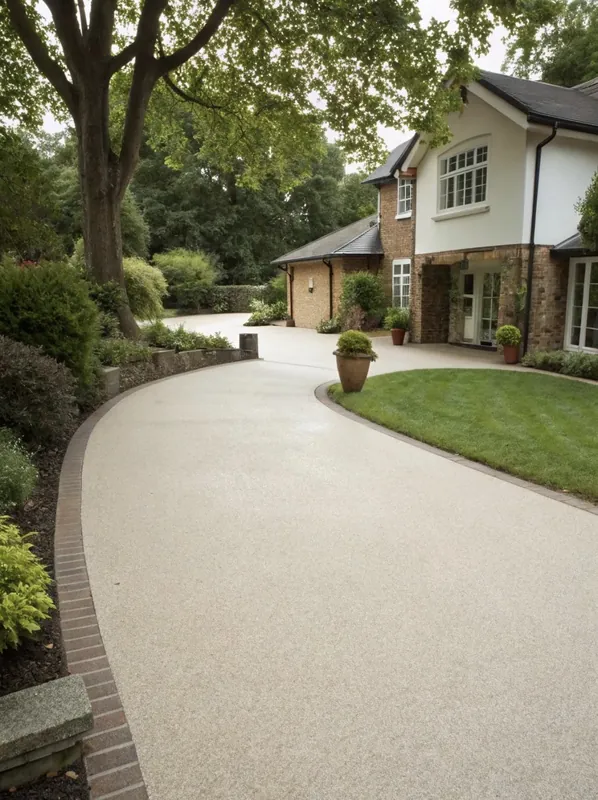
Warm buff & golden blends
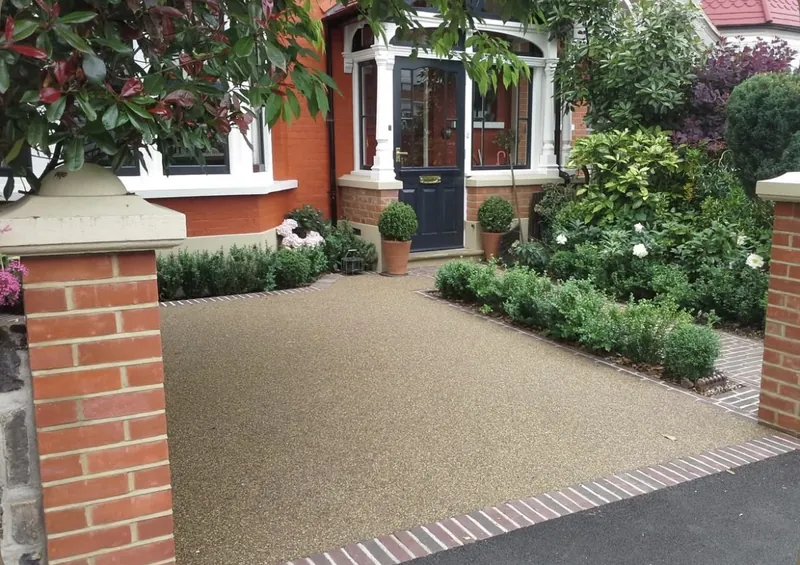
Quartz-rich golds and honey tones that echo gravel — the safest choice against red brick and older render, and the closest match to the traditional driveways of Beaconsfield Old Town and the Chalfonts.
Resin bound surfacing is permeable, UV-stable and seamless. It suits period and modern frontages alike. Installed correctly, it usually needs no planning permission at any size. From £70 per m² installed (2026).
The two systems sound alike and look similar in photographs, but they behave completely differently — practically and legally.
Resin bound surfacing is a cold-mixed blend of aggregate and clear resin, trowelled flat to a depth of around 15–20 mm. Because every stone is coated and the mix is laid with deliberate voids, the finished surface is porous: rain drains through it into the sub-base below. That porosity is what keeps a resin bound driveway within permitted development — under the rules introduced in 2008, front-garden surfacing over 5 m² needs planning permission unless it is permeable or drains to a permeable area. A properly built resin bound system passes that test at any size.
Resin bonded surfacing is different: a film of resin is applied to an existing surface and dry stone is scattered over it. The result looks like loose gravel but is completely impermeable — so on a typical South Bucks frontage it either needs engineered drainage to a lawn or soakaway, or a planning application. It also sheds stone over time and can't bridge cracks in the base beneath it.
We install resin bound systems. Where an existing surface is genuinely sound we'll say so and quote an overlay; where it isn't, we quote the full build-up — and the difference is itemised, never buried.
The full planning rules — including the situations where permission is needed — are in our guide to driveway planning permission and the 5 m² rule.
Resins come in two chemistries. Aromatic resins are cheaper but amber with sunlight — the driveway yellows unevenly, most visibly on lighter blends and in the sunny half of the frontage. Aliphatic, UV-stable resins hold their colour for the life of the surface. On a south-facing Chilterns frontage the difference is obvious within two summers, which is why we quote UV-stable resin as standard rather than as an upgrade.
A permeable surface only works if the layers beneath it drain too. We lay resin bound surfacing over an open-graded, free-draining sub-base rather than standard compacted hardcore, so winter rain moves down and away instead of sitting under the surface and lifting it in frost.
| Factor | Resin bound (what we install) | Resin bonded |
|---|---|---|
| Rainwater | Drains through the surface | Impermeable — runs off |
| Planning over 5 m² | None needed at any size | Needs drainage design or permission |
| Laid depth | 15–20 mm | 3–5 mm scatter coat |
| Surface behaviour | Smooth, stone locked in resin | Loose-gravel texture; sheds stone over time |
| Typical service life | 20–25 yrs | 8–12 yrs |
The blend you choose matters more here than in most places. South Buckinghamshire's older frontages are brick, flint and render under clay tile — warm reds, chalky whites, greys and browns — and the Chilterns design guidance is blunt about avoiding loud, suburbanising surfaces. The good news: natural aggregate blends are exactly what resin bound does best.
Quartz-rich golds and honey tones that echo gravel — the safest choice against red brick and older render, and the closest match to the traditional driveways of Beaconsfield Old Town and the Chalfonts.
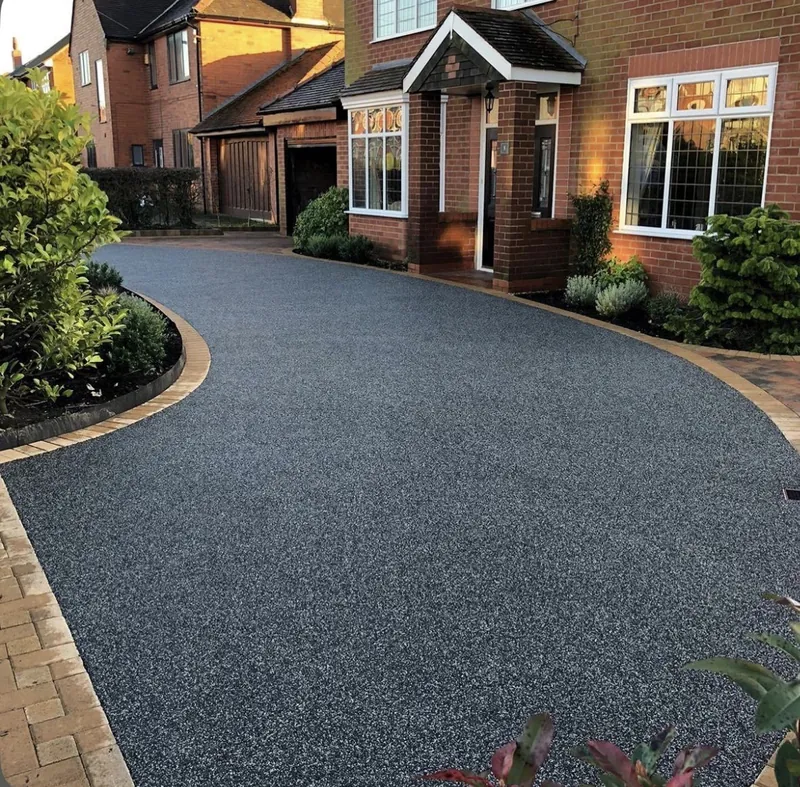
Silver-greys and mixed charcoals that pick up flint walling and slate detailing — quietly modern without fighting a period elevation, and forgiving of leaf-stain and tyre marks.
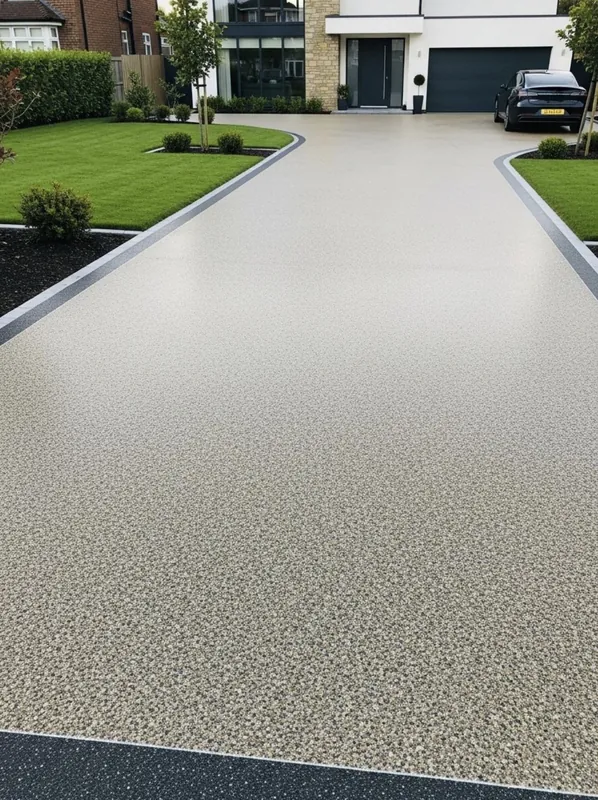
Multi-tone blends with movement in them, sized 2–5 mm, that read as stone rather than carpet. We bring sample boards to the design visit so you judge them against your own brickwork in daylight.
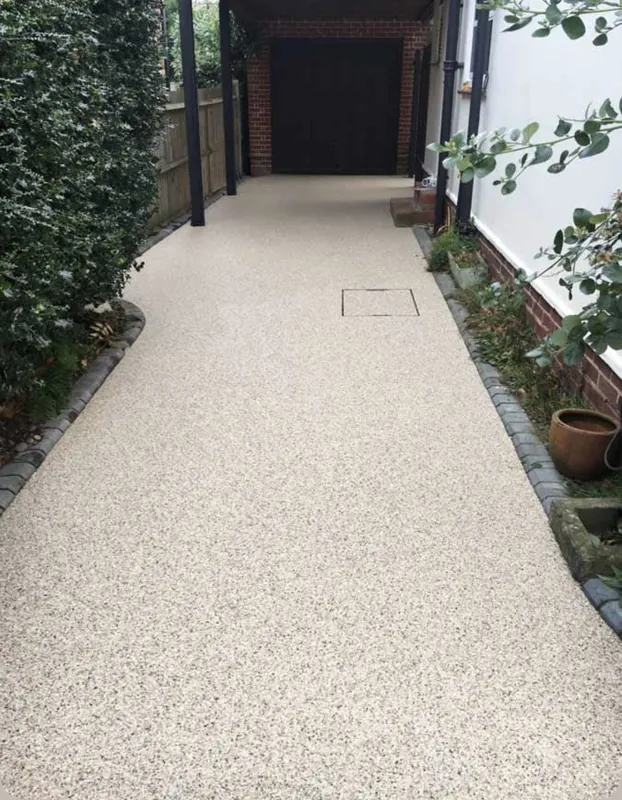
The blends above, on real driveways: golden and cream against period brick, charcoal and silver where a cooler tone suits the house.
Two resin driveways can look identical on handover day and have completely different lives ahead of them, because the difference is buried. When you compare quotes, look for these lines — and be suspicious of any quote that doesn't state them:
Resin chemistry is honest about the British climate: it shouldn't be laid in rain, onto a damp base, or in temperatures near freezing, and summer heat shortens the working time of each mix. We schedule pours around the forecast and tell you if a date needs to move — a day's delay is cheaper than a surface cured wrong.
Resin needs a firm shoulder to finish against: block or sett borders, steel edging, or existing walls. Unrestrained edges are where cheap installations start fraying first, so edge detailing appears as its own line in our quotations.
National guides quote anywhere from £60 to £145 / m² installed, which is honest but unhelpfully wide. The real driver is what happens below the resin: an overlay on a genuinely sound base is a different job from a full excavation with new drainage. Indicative ranges for our area:
| Specification | Typical range | What's included |
|---|---|---|
| Overlay on a sound existing base | £70–£90 / m² | Surface preparation, priming, UV-stable resin bound surface, edge detailing |
| Full build-up (new driveway) | £110–£150 / m² | Excavation to c. 200–250 mm, free-draining sub-base, edge restraints, UV-stable resin bound surface |
| Drainage where the ground needs it | £300–£900 (item) | Soakaway construction and/or threshold channel drains, sized on the design visit |
| Typical 60 m² frontage, full build-up | £7,000–£9,500 | All of the above, itemised in writing |
Ranges assume straightforward access and exclude tree-root complications or retaining work, which we price transparently after the design visit. Every quotation itemises dig-out depth, sub-base specification, drainage and edging — so you can compare it line-by-line against any other quote. For worked examples in Beaconsfield, Gerrards Cross and Penn, see the 2026 resin driveway cost guide.
Measurements, ground assessment, drainage plan, and a check of any conservation-area or Article 4 constraints on your street. You get an itemised written quotation.
Aggregate boards against your brickwork, not under showroom lights. We'll tell you which blends hide leaf-fall and tyre scrub best on a working driveway.
Excavation to the specified depth, free-draining sub-base compacted in layers, edge restraints set on concrete, soakaways and channels installed where the design calls for them.
The resin bound layer is mixed on site and hand-trowelled in one continuous pour. Foot traffic after c. 8 hours, vehicles after 48 hours. You receive aftercare guidance and the written 10-year guarantee.
Usually not: resin bound surfacing is permeable, so it stays within permitted development at any size. The exceptions are streets where an Article 4 direction or conservation-area designation changes the position — parts of Beaconsfield Old Town and the Chalfonts, for example — which is exactly what we check on the design visit before you spend anything.
A properly built system on a free-draining sub-base should give you 20–25 years, and our workmanship guarantee covers the first 10 in writing. Most early failures you'll see locally are overlays applied to cracked bases or aromatic resins that yellowed — both avoidable at specification stage.
Sometimes, and it saves real money when the answer is genuinely yes: the base must be structurally sound, free of movement cracks and already draining somewhere legitimate. We assess that honestly on the design visit — an overlay on a failing base is the most common resin complaint in the industry and we won't quote for one.
We add a fine anti-slip dressing to the final trowel as standard. Aftercare is modest: an occasional sweep, a gentle pressure-wash once or twice a year, and no de-icing salt directly on frost — grit sparingly instead. We leave written aftercare guidance at handover.
It drains through the surface into the open-graded sub-base and then into your ground. On clay-heavy plots — common toward the Chalfonts — infiltration is slower, so we size a soakaway to suit; on chalk it's rarely needed. That drainage design is part of the quotation, not an extra discovered mid-job. For the full picture, read our guide to SuDS-compliant driveway drainage.
Book a free design visit — we'll measure, check your street's planning position, and leave you an itemised quotation to consider in your own time.